Updated on 28 August 2026
ISO/IEC 27001:2022 · third edition
ISO 27001 is a management system. Not a list of controls to tick off.
The standard has two distinct parts: 30 requirement clauses, which describe the system, and 93 Annex A controls, which you select or exclude in writing. ALYDEA covers all 123 lines and produces the 80 types of documents expected. Certification belongs to an accredited body.
- 2022 edition only
- Statement of Applicability generated
- No promise of a certificate
Structure
Two parts, 123 lines.
The clauses describe the management system: this is where certification is decided. Annex A is a catalogue of controls that you justify selecting or excluding.
Requirement clauses (4 to 10)30
- Context of the organisation4
- Leadership3
- Planning5
- Support7
- Operation3
- Performance evaluation6
- Improvement2
Annex A · 4 themes93
- A.5 — organisational controls37
- A.6 — people controls8
- A.7 — physical controls14
- A.8 — technological controls34
The Statement of Applicability (SoA)
This is the pivotal document of the audit: every Annex A control appears in it, selected or excluded, with its justification. ALYDEA generates it from your answers and keeps it up to date when a control changes status.
Source: ISO/IEC 27001:2022, third edition. Scope covered: clauses 4.1 to 10.2 and Annex A.
Where the standard stands
What to know about the edition in force.
No countdown here: ISO 27001 is not a legal obligation, it is a voluntary standard. It is your customers, your tenders or your insurers that make it necessary.
2022 edition
Third edition of the standard
Clauses 4 to 10 keep the structure of management system standards. Annex A is reorganised into 4 themes and 93 controls, against 14 chapters previously.
Transition
The 2013 edition is no longer the audit reference
The transition period from the 2013 edition is behind us: initial, surveillance and renewal audits are held against the 2022 edition. ALYDEA covers only that one.
Ongoing
A cycle, not a project
Management review, internal audit, handling of non-conformities, improvement: the standard asks you to keep the cycle running and to keep a record of it. This is what is most often missing at audit time.
At the end
Certification belongs to an accredited body
No software issues a certificate, and no vendor can guarantee you one. ALYDEA brings you to the audit with a complete file; the body does the rest.
Five workstreams
What the platform absorbs, what stays with you.
An ISMS means living documents and evidence of operation. Producing the documentation is the item that consultancies charge the most for; it is also the most automatable.
Management system
Absorbed by ALYDEA
ISMS manual, scope, security policy, objectives, internal audit programme, management review: generated for your context, versioned, linked to the clauses.
Remains with you
Actually holding the management review and naming those responsible. A document does not replace a meeting.
Risks
Absorbed by ALYDEA
Assessment methodology, risk register, treatment plan, and a Statement of Applicability kept up to date each time a control changes status.
Remains with you
The trade-off: accepting a residual risk commits management. Alex documents the decision; it does not take it.
Annex A
Absorbed by ALYDEA
The 93 controls tracked one by one, with the associated remediation actions (164 in total) and the 80 types of documents expected by the standard.
Remains with you
Deploying the technical controls: encryption, logging, access management, hardening.
Evidence
Absorbed by ALYDEA
Linking to the clause or control, check on receipt, validity period, alert before expiry, full export.
Remains with you
7 actions whose evidence can only come from you: minutes, attestations, configuration extracts.
Certification
Absorbed by ALYDEA
A presentable file with no documentation gaps, and the list of gaps still open before you call in the auditor.
Remains with you
The certification audit itself, carried out by an accredited body. ALYDEA does not certify and does not stand in for the body.
Figures taken from the ISO/IEC 27001:2022 framework and its action catalogue. 71 of the 164 actions are purely operational: they produce no document, only evidence of execution.
The path
Four steps, in this order.
The classic mistake is to start with Annex A. Without a written scope or a risk assessment, the 93 controls have no justification to put in front of the auditor.
1Scope
The ISMS scope
Context, interested parties, scope, management commitment: clauses 4 and 5 condition everything else, and they are what the auditor opens first.
2Assess
The 123 requirements
Clauses and Annex A controls reviewed one by one, with a score per theme and the list of qualified gaps.
3Close the gaps
Documents and controls
The expected documents are generated for your context, the controls to deploy come out as prioritised actions, and the Statement of Applicability follows automatically.
4Maintain
The improvement cycle
Internal audit, management review, non-conformities, revalidation of actions and renewal of evidence: the file stays defensible between two surveillance audits.
In the product
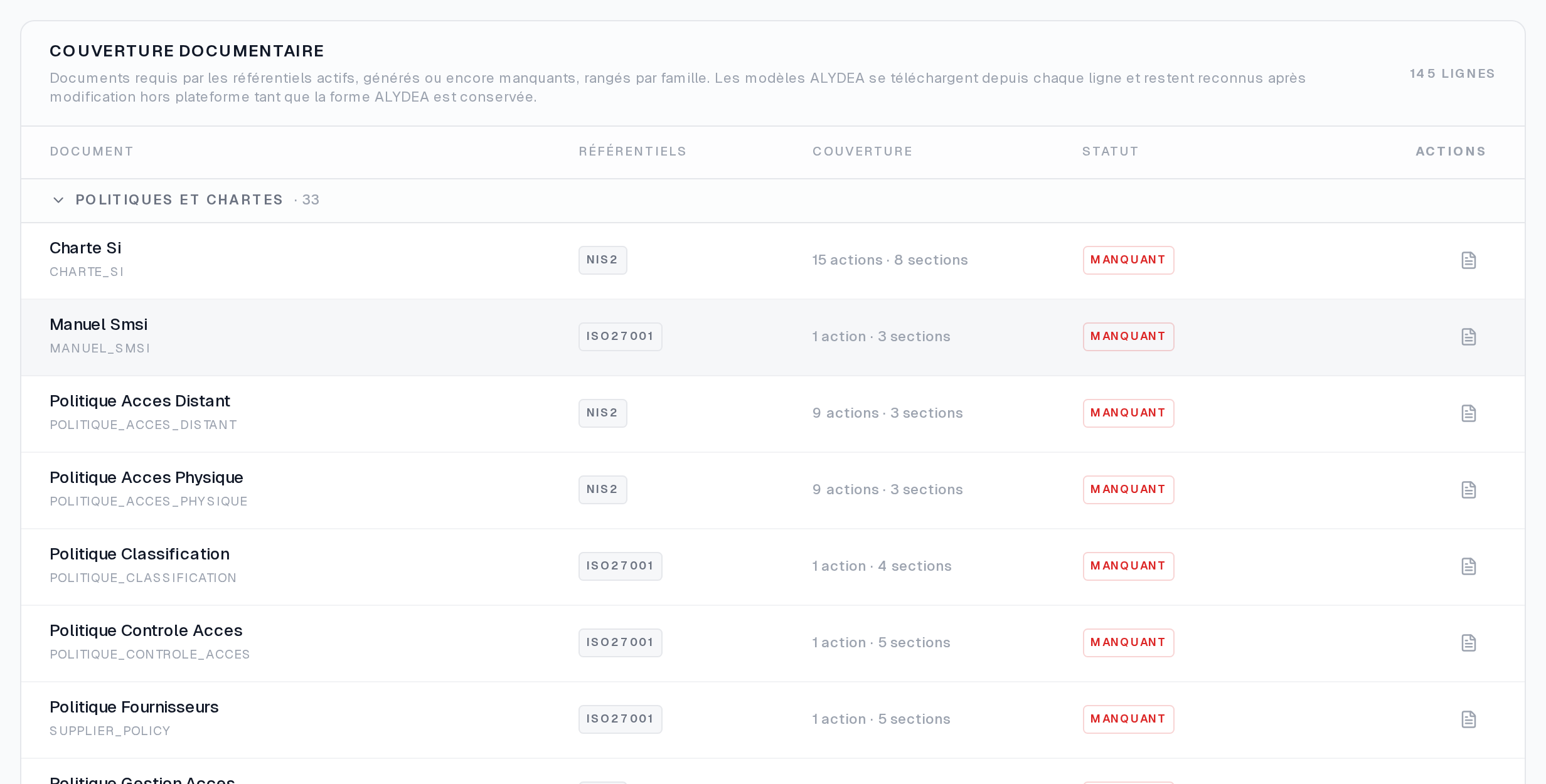
Documentation coverage, document by document.
Each document expected by the active frameworks appears with its framework, the number of actions and sections it covers, and its status. ALYDEA templates can be downloaded from each line and are still recognised after being edited outside the platform.
Frequently asked questions
ISO 27001: what we are asked.
Does ALYDEA issue ISO 27001 certification?
No, and nobody can except an accredited certification body. ALYDEA prepares the file: management system documents, Statement of Applicability, linked evidence, gaps still open. The certification audit remains a third-party audit.
What is the difference between the clauses and Annex A?
The 30 clauses of chapters 4 to 10 are requirements: they are not negotiable. The 93 Annex A controls are a catalogue: you may exclude some, provided you justify it in the Statement of Applicability. That justification is what the auditor comes to read.
Do we need a formal risk assessment?
Yes. Clause 6.1 requires a risk assessment and treatment process, and the treatment plan must be approved. ALYDEA provides the register, the methodology and the plan; the assessment itself is carried out with your teams, and accepting a residual risk is a management decision.
We are aiming at NIS2: is ISO 27001 of any use?
Part of the work is common: the security policy, incident management, supplier security clauses and the asset inventory are shared in ALYDEA. The two frameworks remain distinct: ISO 27001 asks for a management system and proof that it operates, whereas NIS2 imposes security objectives and a supervisory regime.
How many documents do we need to write?
The ALYDEA ISO 27001 catalogue has 80 types of documents, from the ISMS manual to registers and audit programmes. Not all of them apply to every organisation: the scope and the Statement of Applicability determine which are actually expected in yours.
See also
The pages that go with it.
- NIS2The French regime, with its security objectives and entity status.
- DORAThe financial sector regulation, which takes up part of what an ISMS expects.
- ANSSI hygiene guideThe technical baseline, useful before opening a certification project.
- ISO 27001 mock audit checklistScoping, evidence and reporting for an ISO 27001 engagement.
- NIS2 or ISO 27001?A voluntary standard versus a legal obligation being transposed.
- ISO 27001 or DORA?What an ISMS brings to a DORA file, and what it does not.
- ISMSThe management system described by clauses 4 to 10.
- Statement of ApplicabilityThe item the auditor opens first.
- ISO 27001 mock audit (consultants)The mock audit path designed for firms and consultants.
Start by finding out how many clauses stand up.
The assessment covers the 30 clauses and the 93 Annex A controls, qualifies the gaps and produces the first version of your Statement of Applicability. Free, no credit card.