Updated on 28 August 2026
DORA (Regulation (EU) 2022/2554) · financial sector
DORA already applies. What is usually missing is the record.
The regulation on digital operational resilience for the financial sector has been directly applicable since 17 January 2025. ALYDEA covers 122 of its requirements, grouped into 13 pillars, across Articles 4 to 15, 17 to 20, 23 to 30 and 45, and builds in four level 2 texts, including the format of the register of information.
- Level 1 and level 2 built in
- Register in the 2024/2956 format
- Dated sources
Structure
Thirteen pillars, 122 requirements.
The framework follows the chapters of the regulation, article by article. Obligations that fall on authorities rather than on entities are left out.
Governing ICT risk24
- Governance and organisation (Art. 4-5)13
- ICT risk management framework (Art. 6-7)11
Controlling the lifecycle47
- Identification (Art. 8)7
- Protection and prevention (Art. 9)9
- Detection (Art. 10)4
- Response and recovery (Art. 11-12)17
- Learning and evolving (Art. 13)7
- Communication (Art. 14)3
Incidents and testing34
- Incidents: classification, reporting (Art. 17-20, 23)16
- Resilience testing (Art. 24-25)7
- Threat-led penetration testing, TLPT (Art. 26-27)11
Third parties and ecosystem17
- ICT third-party service providers (Art. 28-30)14
- Information sharing (Art. 45)3
ICT register of information
Three actions lead to it, and ALYDEA provides a template in the format of Annexes I to IV of Implementing Regulation (EU) 2024/2956. Checking the schema and submitting it to your competent authority remain on your side: we do not promise an export that is ready to file.
As it stands, the whole grid applies whatever your profile: ALYDEA does not yet filter requirements by type of financial entity (microenterprise, payment institution, entity designated for TLPT).
Source: DORA (Regulation (EU) 2022/2554) of 14 December 2022. Level 2 built in: Delegated Regulations (EU) 2024/1772 and 2025/301, Implementing Regulations (EU) 2025/302 and 2024/2956.
Where the text stands
A regulation in force, a level 2 still in progress.
DORA does not need transposition: the regulation applies directly. What keeps arriving are the technical standards that specify how it is implemented.
14 December 2022
Adoption of Regulation (EU) 2022/2554
The regulation on digital operational resilience for the financial sector is adopted on the same day as the NIS 2 directive.
17 January 2025
Entry into application
From this date, the requirements are enforceable against the financial entities concerned, with no prior national implementing text.
Level 2 built in
Four texts already taken into account
Incident classification (2024/1772), content and deadlines for reporting (2025/301), standard forms (2025/302), templates for the register of information (2024/2956).
Level 2 remaining
Four texts not yet built in
ICT risk management tools and policies (2024/1774), policy on critical functions (2024/1773), subcontracting (2025/532), TLPT criteria and methodology (2025/1190). The corresponding requirements are described at level 1 only.
Five workstreams
What the platform absorbs, what stays with you.
DORA is the most prescriptive of the four frameworks detailed on this site: mandatory formats, quantified deadlines, standardised registers. It is also the one where the gap between actual practice and the written record is most visible.
Governance
Absorbed by ALYDEA
ICT risk management framework, resilience strategy, policies and roles: 37 types of documents expected, generated for your context and linked to the articles.
Remains with you
The involvement of the management body, which Article 5 holds explicitly responsible for the framework.
Incidents
Absorbed by ALYDEA
The 16 requirements of the incidents pillar, with the classification and deadlines from Regulations 2024/1772 and 2025/301 and the standard forms of 2025/302.
Remains with you
The reporting itself to your competent authority, within the deadlines, under your responsibility.
ICT register of information
Absorbed by ALYDEA
A template in the format of Annexes I to IV of Implementing Regulation 2024/2956; automatic filling from your supplier register is in preparation.
Remains with you
Checking the schema and submitting the register to the authority: we provide the template, not the regulatory filing.
Resilience testing
Absorbed by ALYDEA
Testing programme, scope, expected scenarios and follow-up of the remediation arising from the results.
Remains with you
Running the tests, and the TLPT when your authority designates you: it is carried out with qualified testers.
Third-party providers
Absorbed by ALYDEA
The 14 requirements of the third-party pillar: register of arrangements, mandatory contractual clauses, exit strategy, monitoring of critical functions.
Remains with you
Negotiating with your providers, and the decision to exit a contract.
The ALYDEA DORA framework has 128 actions and 260 pre-audit questions, each linked to an expected document. It is the only one of the four frameworks detailed on this site to cover that link end to end.
The path
Four steps, in this order.
The regulation already applies: the urgency is not to write everything, but to know precisely what is missing and in what order to close it.
1Scope
Scope and critical functions
Identify the critical or important functions, the ICT assets that support them and the providers involved: this is the basis of Article 8 and of the register of information.
2Assess
The 122 requirements
The 13 pillars reviewed article by article, with level 2 clarifications where they are built in, and a score per pillar.
3Close the gaps
Documents, clauses and register
128 remediation actions, the 37 types of documents expected and the register of information template in the regulatory format.
4Maintain
Incidents, testing, contracts
Testing deadlines, contract reviews and evidence renewals stay tracked: DORA is demonstrated continuously, not once a year.
In the product
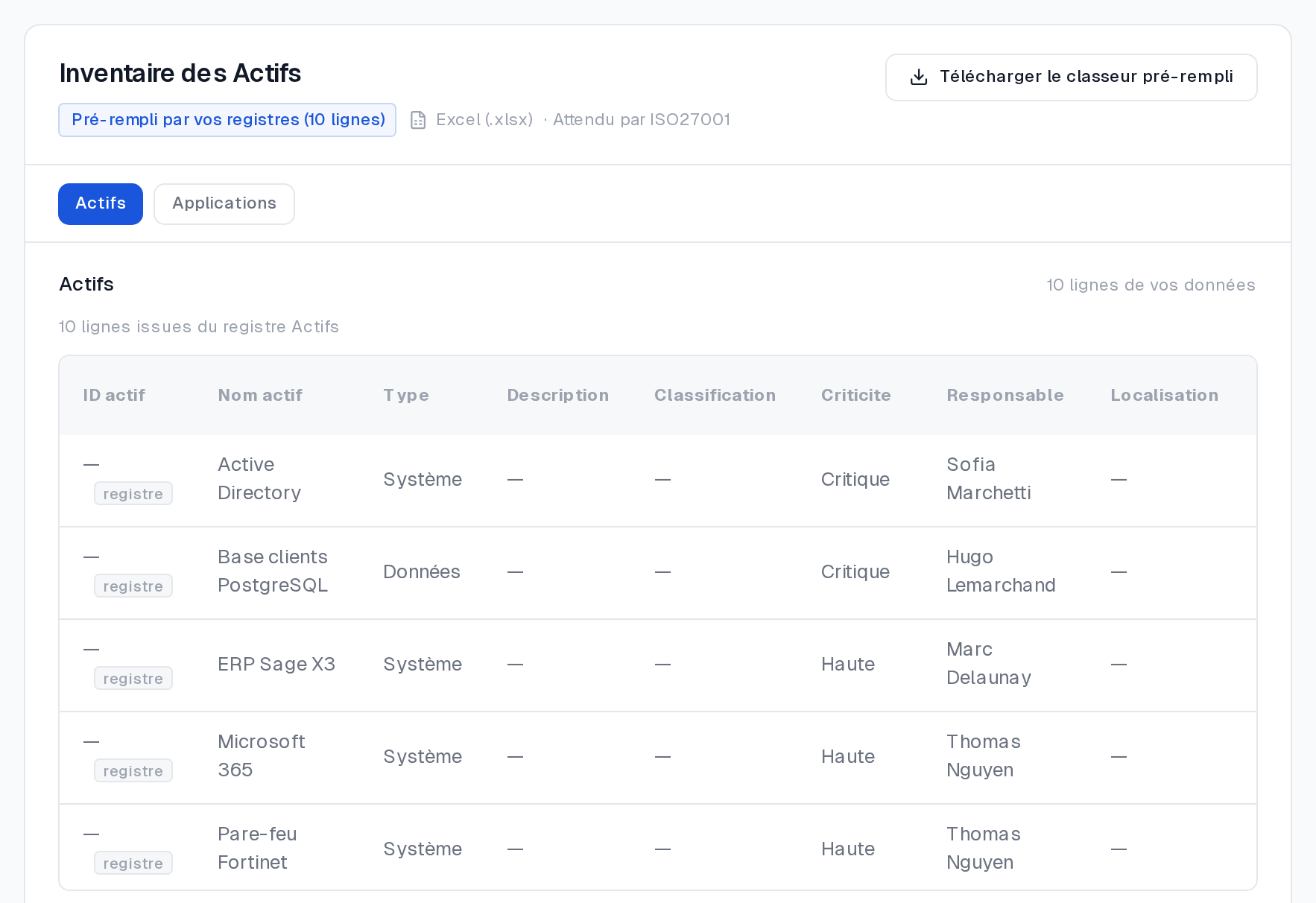
A workbook pre-filled from your registers.
The registers kept in the workspace (assets, applications, suppliers) feed the workbooks expected by the frameworks. The workbook downloads in Excel format, line by line, showing what comes from your data and what remains to be completed.
Frequently asked questions
DORA: what we are asked.
Who is in scope of DORA?
The financial entities covered by the regulation: credit institutions, payment and electronic money institutions, investment firms, insurers, central securities depositories, central counterparties, crypto-asset service providers, among others, as well as their ICT third-party service providers under Chapter V.
Does ALYDEA submit the register of information to the authority?
No. We provide a template in the format of Annexes I to IV of Implementing Regulation (EU) 2024/2956, pre-filled from your registers. Validating the schema and submitting it to your competent authority remain your responsibility: we would rather say so than let you find out on the filing date.
Is the scope adapted to our entity profile?
Not yet. The framework carries the regime information for each requirement, but it is not used as a filter: the complete grid applies to any audited entity. In practice, you will see requirements that do not concern you, for example TLPT if your authority has not designated you.
What exactly does level 2 cover?
Four texts are built in: incident classification (2024/1772), content and deadlines for reporting (2025/301), standard forms (2025/302) and templates for the register of information (2024/2956). Four others are not yet; the requirements concerned remain described at the level of the regulation, without the values and formats set by those technical standards.
How does this relate to NIS2 and ISO 27001?
A financial entity can fall under DORA and aim at ISO 27001 at the same time; some also fall under NIS2 for activities outside the financial perimeter. Supplier security clauses, incident management, the security policy and the asset inventory are shared in ALYDEA: the action is done once and counts for the frameworks it covers.
See also
The pages that go with it.
- NIS2The French regime, applicable to sectors other than finance.
- ISO 27001The management system often required in parallel by counterparties.
- ANSSI hygiene guideThe technical baseline, upstream of the resilience requirements.
- NIS2 or DORA?A regulation already in application versus a directive to transpose.
- ISO 27001 or DORA?A voluntary certificate versus a supervisory regime.
- ICT register of informationThe deliverable in the format imposed by Regulation 2024/2956.
- PSSIThe policy expected under protection and prevention.
- All frameworksWhat overlaps, and what does not.
The regulation already applies. The file is built over time.
The assessment covers the 13 pillars, qualifies the gaps and produces the expected documents, register of information included. Free, no credit card.